
This is an old revision of the document!
Results of the PMO Theory Approach
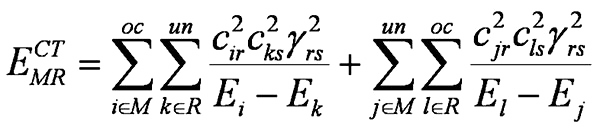
The PMO theory remains the best tool to discuss the reactivity of various chemical reactions. Our reaction is a suitable case for its application and, moreover, in π-approximation. The interaction energy of the PMO theory, also called "charge transfer" (CT) energy, has a well-known form:
(eq. 1)
where the summing is done over a set of spin orbitals and γ is the resonance integral on the atomic orbitals (AO) of reactive centers r and s.
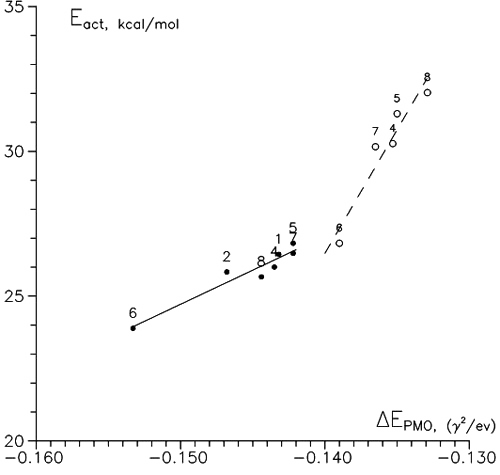
Using RHF π-orbitals of isolated reagents we calculated CT energies (ECT) of all series in consideration (see, e.g., Tables V and VI). Figure 4 shows that there is some symbasis between them and the activation barriers of corresponding reactions. Addition to a substituted position (α-addition) gives less satisfactory correlations, that are obviously caused by a greater steric effect (deformation of reaction center).
So, ECT could also be taken for another factor of reactivity. But, there is one inconvenience with it: it is not an ordinary index of reactivity; it is the whole set of energies of MO s and their coefficients of the AO s of the reaction center. It is no wonder that when using the PMO theory researchers frequently truncate orbital sets to HOMO and LUMO to avoid the summing in Eq. (1); this method is known as the frontier molecular orbitals (FMO) approach.
Although FMO cannot be approved as a true approximation (see Footnote), it has an obvious advantage: the coefficients and energies of FMO may be used as indices of reactivity.
The use of localized molecular orbitals can serve as another approach. For example, using a projective procedure we managed to build a pair of localized MOs of a monomer that combined ≈95% of π-density both of occupied and unoccupied shells. It is a pity that even 5% is too great an error for such sums as Eq. (1). So, a desire arises to "correct" the energies (or coefficients) of such localized orbitals in such a way that they would give exact values of the sums in Eq. (1). As a result, we would get some fictitious but effective orbitals.
Now, we are going to propose an alternative notation of the PMO Eq. (1), that gives such effective MO s.
Table V. HOO• addition to vinyl monomers. Ea, kcal/mol; ECT, (γ2/eV); N и G, eV.
| Monomer | β-attack | α-attack | ||||||
|---|---|---|---|---|---|---|---|---|
| Ea | ECT | N | G | Ea | ECT | N | G | |
| Eth | 26.4 | −0.286 | 1.304 | 14.1 | ||||
| Prop | 25.8 | −0.294 | 1.147 | 13.7 | 31.0 | −0.285 | 1.460 | 14.2 |
| AN | 26.0 | −0.287 | −1.740 | 14.1 | 30.3 | −0.271 | 0.284 | 14.8 |
| MA | 26.8 | −0.284 | −2.187 | 14.4 | 31.3 | −0.270 | 0.726 | 14.8 |
| VA | 23.9 | −0.307 | 2.011 | 13.3 | 26.8 | −0.278 | 0.738 | 14.4 |
| VCl | 26.5 | −0.284 | −0.355 | 14.1 | 30.2 | −0.273 | 0.233 | 14.7 |
| VCl2 | 25.7 | −0.289 | −1.625 | 14.0 | 32.0 | −0.266 | −0.459 | 15.1 |
| St | 23.0 | −0.311 | 1.371 | 13.0 | ||||
| ViNaph | 22.7 | −0.313 | 1.379 | 12.9 | ||||
| 2ViPy | 23.3 | −0.303 | 0.788 | 13.3 | ||||
| 4ViPy | 23.4 | −0.299 | 0.125 | 13.4 | ||||
| Bu2ene | 22.6 | −0.310 | 1.395 | 13.1 | ||||
| Hex3ene | 21.8 | −0.315 | 1.400 | 12.9 | ||||
Table VI. CH3• addition to vinyl monomers.
| Monomer | β-attack | α-attack | ||||||
|---|---|---|---|---|---|---|---|---|
| Ea | ECT | N | G | Ea | ECT | N | G | |
| Eth | 13.9 | −0.349 | −0.735 | 11.5 | ||||
| Prop | 13.6 | −0.359 | −0.960 | 11.2 | 18.1 | −0.348 | −0.675 | 11.5 |
| St | 11.4 | −0.378 | −1.054 | 10.7 | −0.344 | −0.766 | 11.7 | |
| AN | 13.0 | −0.391 | −3.405 | 11.3 | 17.0 | −0.355 | −1.714 | 11.5 |
| MA | 13.4 | −0.388 | −3.738 | 11.5 | 18.0 | −0.349 | −1.342 | 11.6 |
| VA | 12.1 | −0.370 | −0.385 | 10.8 | 16.7 | −0.346 | −1.353 | 11.7 |
| VCl | 13.3 | −0.369 | −2.216 | 11.3 | 16.9 | −0.354 | −1.716 | 11.5 |
| VCl2 | 12.6 | −0.396 | −3.343 | 11.1 | 19.6 | −0.363 | −2.394 | 11.5 |
Figure 4. Relationships between activation energies and CT energy of the PMO method, HOO addition. •, β-attack; ○, α-attack. 1, Eth; 2, Prop; 3, St; 4, AN; 5, MA; 6, VA; 7, VCl; 8, VCl2.
Footnote:
In our case the FMO approach failed entirely, for example, styrene having the most reactive C=C bond (both experimental and calculational data) appears to be completely inert from the point of view of the FMO approach. Obviously, this is due to truncation of many π-orbitals in this case, not to the different electronic structure of styrene.