
This is an old revision of the document!
Energy Partitioning
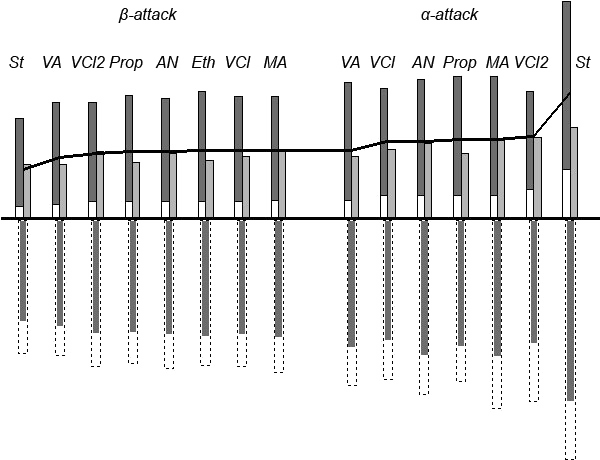
Although we have obtained a powerful index of reactivity we remain uncertain of the factors that determine that reactivity. So, let us turn to energy partitioning and divide activation energies into their main parts: energies of former reagents, ER and EM, and interaction energies, Eint. Figure 2 shows the results of such partitioning. The whole situation seems to be complicated enough, each of those parts being greater in absolute value than the resulting activation energy, and no clear correlations are visible. Moreover, intermolecular interaction energy values are antibate to activation energies, so they cannot be the main and the only factor of reactivity.
It was mentioned above that the deformation movement of vicinal substituents of the reaction center is the main part of the IRC at the TS point. So, we could expect a possible relationship between energies of a monomer's deformations (Edef) and activation energies.
The energy partitioning procedure gives only the energy of the "reactant molecule" within the supermolecule, the energy comprising not only deformation but also electronic rearrangement. So let's define deformation energy Edef of a molecule as the energy, associated with the change in the its geometry to that one that it has in the TS. Calculation of such values (Edef) shows that they indeed correlate with the activation barriers surprisingly well (see Fig. 3).
Nevertheless, Edef cannot be a true parameter of reactivity – the degree of tortion directly depends on the distance between reagents in TS, which, in turn, depends on the reagents' reactivity itself. We need to adjust deformation to some standard conditions, for example, an average of considered geometries of TSs1). The values of such «standard» deformation energies (E0def) are shown in Table IV.
Figure 3 shows that there exists a close relationship between activation energy of addition and E0def of monomers. That means that vinyl monomers endure tortion with ease compared with their reactivity. However, this does not mean that reactivity is but an elastic property of a monomer because neither calculated force constants of valent C=C vibration nor umbrella CH2 vibration correlate with ΔΔH≠f2). Moreover, it was found from other dependencies (other radicals' addition) that polar factors were also present: The monomers with acceptor group (VCl, MA, AN) had extra activity in reactions with CH3•; and vice versa, with CF3• or CH3O• they lacked some activity.
Thus, the complete description of the radical addition reaction requires the simultaneous consideration of these two terms: intra- and intermolecular reforming. Let us choose E0def to represent the first factor. And the second, intermolecular term, can be described by means of the PMO theory, especially since our case is a good one for π-approximation.
Figure 2. Partitioning of activation energies of reactions HOO• + CH2CHX.
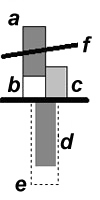 Details of histogram:
(a), EM, the change of monomer's total energy including Edef, (b); (c), ER, the change of total energy of HOO; (d), Eint, total energy of interaction; the dashed block (e) shows the value of interaction between reactive centers; (f), resulting value of activation barrier Ea (ΔΔH≠f).
Figure 3.
Relationship between Ea of HOO β-addition and energies of deformation of vinyl monomers, kcal/M.
1—deformation to geometry of TS, 2 — "standard" deformation E0def.
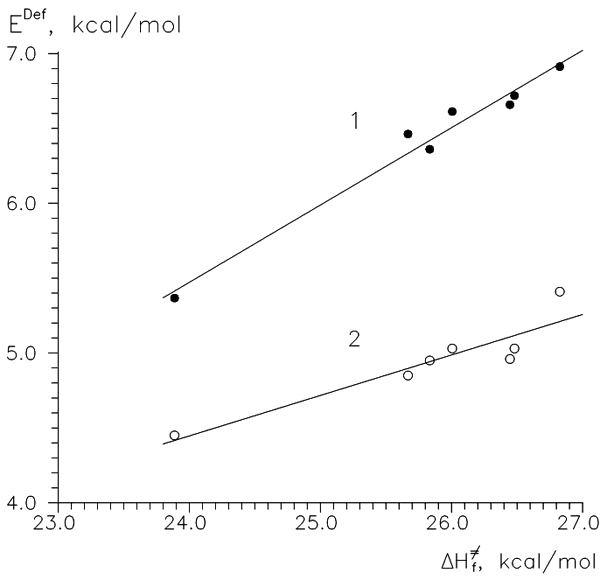
Table IV. Energies of standard deformation (E0def) of vinyl monomers (kcal/mol).
| E0def | Eth | Prop | AN | MA | VA | VCl | VCl2 | St |
|---|---|---|---|---|---|---|---|---|
| β-position | 6.83 | 6.51 | 6.57 | 7.01 | 5.64 | 6.56 | 6.07 | 4.83 |
| α-position | 7.45 | 7.19 | 7.65 | 6.10 | 7.08 | 6.96 | 7.88 |