Empirical Schemes of Vinyl Monomers' Relative Reactivity in Radical Addition Reactions
Variant I
In the previous paragraph we proposed to try Eq. (3), or just its polar part, as a basis of nonlinear empirical schemes of reactivity. This approach is intended for calculation or prediction of rate constants (or activation barriers) in cases when the differences in the structure of reagents are too great to use linear correlation schemes of the Hammett type. Let us try to build a scheme of reactivity of vinyl monomers in radical addition reactions. Firstly, we can use only the form of Eq. (3), its parameters being the variables for the optimization procedure. On the other hand, we can try to use theoretically obtained parameters of vinyl monomers as indices of reactivity and correlate experimental data with them.
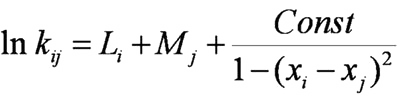
Both variants were studied. Let's start from entirely empirical method, the first approach. For this purpose we are going to use a slightly simplified form of Eq. (3) (supposing only N, effective electronegativity, influences the value of CT energy1) ):
(eq. 4)
where Li and xi are parameters of a radical, and Mj and xj – of a monomer (x is electronegativity of a reactant; L и M collect entropy, nonpolar effects, and so on). Since only relative rate constants of radical addition to monomers were considered (ln kij/kik), parameter L never appeared. Parameterization of the scheme was accomplished on the basis of approximately 200 rate constants [ 1, 7, 9 ] of reactions between 20 chosen radicals and 20 vinyl monomers. All obtained parameters are shown in Table IX (see more data in Ref. [ 10 ]). Comparison of calculated values with experimental data are shown in Figure 7. It enables us to say that the proposed scheme describes these experimental data reasonably well (the mean deviation is less than 50%, the precision of those kinetic data themselves). So, the form of Eq. (4) is both meaningful and adequate for the purposes of nonlinear correlation tasks. It is relevant to add here that all parameters also "correlate" with common chemical views on donor–acceptor properties of both the radicals and monomers that were considered.
TableIX. Optimized parameters of reagents, Eq. (4). Const = 27.5
| Monomers | Radicals | ||||
|---|---|---|---|---|---|
| M | x | x | |||
| St | 02) | 0 | CH3• | 0.477 | |
| MSt3) | 0.284 | 0.0081 | t-Bu• | 0.518 | |
| AN | −1.908 | −0.0559 | c-C6H11• | 0.587 | |
| MAN | −1.585 | −0.0218 | 5-C6H9• | 0.528 | |
| MA | −2.085 | −0.0482 | C6H5• | 0.310 | |
| MMA | −1.006 | −0.0315 | C6H5-S• | −0.534 | |
| VA | −4.582 | −0.0285 | t-BuO• | −0.482 | |
| IPA | −4.061 | −0.0149 | t-BuOO• | −0.541 | |
| VBuE | −5.200 | 0.0102 | PhC(CH3)2OO• | −0.372 | |
| 2-ViPy | 0.251 | −0.0122 | CCl3• | −0.204 | |
| 4-ViPy | −0.023 | −0.0114 | CF3• | −0.627 | |
| 1,1-DPE | 1.216 | 0.0122 | |||
| 1,2-DPE | −1.660 | 0.0093 | poly-St4) | 0.446 | |
| VCl | −3.034 | −0.0253 | poly-MSt | 0.598 | |
| VCl2 | −2.097 | −0.0449 | poly-AN | −0.293 | |
| VF | −5.087 | −0.0219 | poly-MAN | 0.072 | |
| VF2 | −3.522 | −0.0604 | poly-MA | 0.157 | |
| Eth | −4.431 | −0.0167 | poly-MMA | 0.088 | |
| MVK | −1.729 | −0.0561 | poly-VA | 0.067 | |
There are experimental data on reactivity of radicals and vinyl monomers that have substituted benzoic ring in theirs structure. In the process of parametrization we assumed that substituent in such aromatic compounds only shifts EN of the reagent: xi=xH + ρ·σi, where ρ is the sensitivity quotient and σi is the parameter of substituent (they correspond both by the meaning and value the Hammett's ρ/σ parameters [ 2 ]); see Table X.
Table X. Parameters5) of substituents (σ) in aromatic ring. Sensibility of aromatic groups for substitution (ρ).
| substituent | σ6) | Group | ρ | |
|---|---|---|---|---|
| p-NH2 | 0.111 | Ph-S• | 1.07) | |
| p-OCH3 | 0.042 | PhCH=CH2 | 0.145 | |
| p-CH3 | 0.004 | PhCH•∼ | 0.936 | |
| p-Cl | −0.013 | Ph• | 2.4 | |
| p-Br | −0.009 | |||
| p-CN | −0.030 | |||
| p-NO2 | −0.041 |
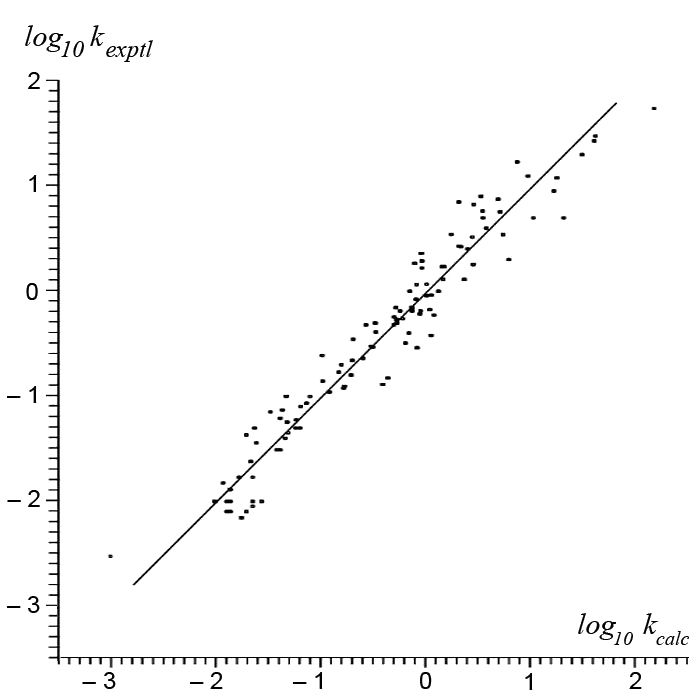 Figure 7. Relationship between experimental relative rate constants and calculated values by Eq. (4).