
en:reactivity:radical_addition:altpmo
This is an old revision of the document!
Alternative Form of the PMO Equation: Effective Electronegativity of Reagent
Eq. (1) can be rewritten as:
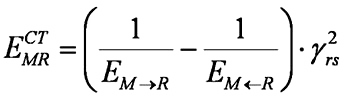 ,
where
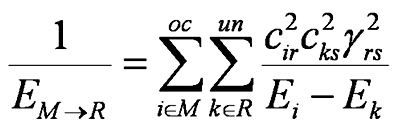 and
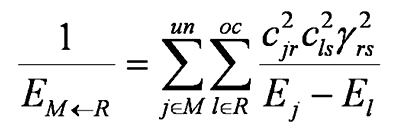 (Eq. 1' )
Values EM→R and EM←R can be regarded as the efficient energies of occupied and unoccupied orbital shells of the first reagent M related to the orbitals of the second reagent R. A more convenient notation looks like this:
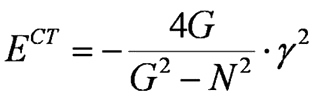 ,
where N = EM→R + EM←R and G = EM←R − EM→R. (Eq. 2)
Let us call parameter N by analogy with the Mulliken formula1) the efficient electronegativity (N) of reactive center (which describes acceptor/polar properties) and G the efficient energy gap between interacting orbital shells (which characterizes activity/sensitivity, covalent characters of interaction). As follows from the definition, parameters N and G are not characteristics of a whole reagent but of a certain reactive center. These parameters are useful in discussions concerning reactivity. For example, most simple vinyl monomers have similar values of G so their reactivity can be explained by N only. The dependence of CT energy upon N is of parabolic type with maximum at N = 0. That means that in the case when N of reagents coincide, stabilization via ECT is the lowest. The group of monomers with conjugated double bonds (butadiene, styrene, vinylpyridene, etc.) were found to have close EN but strongly differed by energy gap between occupied and unoccupied orbital shells. In such a case, reactivity could be entirely explained by the factor G (see Table V). N is also convenient for discussions of electron donating and related polar effects. For example, EN satisfactorily correlates with charge transfer from monomers to the attacking radical.
1)
Electronegativity = ½ (EHOMO + ELUMO)
en/reactivity/radical_addition/altpmo.1789571138.txt.gz · Last modified: by abc